


How to select Siemens frequency converters? What should be
noted when selecting Siemens frequency converters
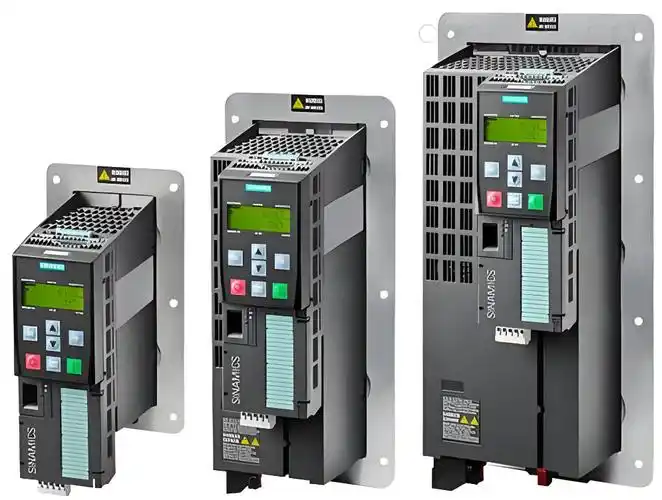
Siemens frequency converter
Introduction to Siemens frequency converter
Siemens frequency converter is a well-known brand of frequency converter developed, produced, and sold by Siemens AG in Germany. It is mainly used to control and regulate the speed of three-phase AC asynchronous motors. And with its stable performance, rich combination functions, high-performance vector control technology, low-speed high torque output, good dynamic characteristics, super strong overload capacity, innovative BiCo (internal function interconnection) function, and unparalleled flexibility, it occupies an important position in the frequency converter market.
The earliest use of Siemens frequency converters in the Chinese market was in the steel industry. However, at that time, motor speed regulation was still mainly based on DC speed regulation, and the application of frequency converters was still an emerging market. However, with the continuous development of electronic components and the continuous maturity of control theory, frequency converter speed regulation has gradually replaced DC speed regulation and become the mainstream of drive products. Siemens frequency converters have achieved super scale development in this huge Chinese market due to their strong brand effect. Siemens’ successful development in the Chinese frequency converter market can be said to be a perfect combination of Siemens brand and technology. The early Siemens frequency converters we encountered in the Chinese market mainly included SIMOVERTA for current sources and SIMOVERTP for voltage sources. These frequency converters also entered the Chinese market mainly due to the introduction of equipment and are still in small use. Later, the main ones sold in the Chinese market were MICROMASTER and MIDIMASTER, as well as the most successful series of Siemens frequency converters, SIMOVERTMASTERDRIVE, which is commonly known as the 6SE70 series. It not only provides AC frequency converters for general use, but also offers DC bus solutions for multi motor drives required in special industries such as papermaking and chemical fiber. Of course, Siemens has also launched an ECO frequency converter that, in my personal opinion, was technically a failure but has been quite successful in the market. The technical failure was mainly due to its high failure rate, while the market success was mainly due to it surpassing Fuji frequency converters to become the top brand in the Chinese market. Currently, Siemens’ main models in the Chinese market are the MM420 and MM440.6 SE70 series.
Parameter Setting of Siemens Inverter
The frequency converter has multiple set parameters, each with a certain selection range. In use, it is common to encounter the phenomenon of the frequency converter not working properly due to improper setting of individual parameters.
Control methods: speed control, torque control, PID control, or other methods. After adopting the control method, static or dynamic identification is generally required based on the control accuracy.
Minimum operating frequency: refers to the minimum speed at which the motor operates. When the motor operates at low speeds, its heat dissipation performance is poor, and prolonged operation at low speeds can cause the motor to burn out. Moreover, at low speeds, the current in the cable will also increase, which can cause the cable to heat up.
Maximum operating frequency: Generally, the maximum frequency of a frequency converter is up to 60Hz, and some even up to 400Hz. High frequency will cause the motor to run at high speed, which is why the bearings of ordinary motors cannot operate at their rated speed for a long time. Can the rotor of the motor withstand such centrifugal force.
Carrier frequency: The higher the carrier frequency is set, the larger the high-order harmonic components, which is closely related to factors such as cable length, motor heating, cable heating, and frequency converter heating.
Motor parameters: The frequency converter sets the power, current, voltage, speed, and maximum frequency of the motor in the parameters, which can be directly obtained from the motor nameplate.
Frequency hopping: At a certain frequency point, resonance may occur, especially when the entire device is relatively high; When controlling the compressor, avoid the surge point of the compressor.
How to select Siemens frequency converter
The MM4 series is Siemens’ main low-end frequency converter sold in China in recent years, forming a low to high combination with its 6SE70/71 series engineering frequency converter.
MM4 has a power of less than 250KW, while 6SE70/71 can cover the range of 2.2-2300KW; MM4 focuses on simple applications and is relatively inexpensive, while 6SE70/71 focuses on high-performance and multi machine transmission solutions and is relatively expensive. Within MM4, it is further divided into MM410/420/430/440 to target multiple different market directions, reduce its configuration and costs, and enhance its competitiveness.
Differentiate by function:
MM440 belongs to the universal frequency converter series, including the MACROMASTER series of MM410420430 products, with a rated power range from 120kw to 200kw (constant torque (CT) control mode), or up to 250kw (variable torque (VT) control mode).
6SE70 belongs to large-scale transmission, with a standard device range from 2.2kw to 2300kW. The voltage ranges from 380V to 690V. There are two types of 6SE70: book type and cabinet type. However, this device has been discontinued at present.
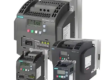
SINAMICS is Siemens’ latest generation of frequency converter products, divided into two families: G (ordinary type) and S (high-performance type). Micromaster, Masterdrive and other frequency converters will eventually be unified into the SINAMICS series products.
The SINAMICS series is a new generation of frequency converters, divided into S series and G series, including:
The S series is an upgrade of the MasterDriver engineering frequency converter 6se7 series. In fact, it has already covered various driving ranges (including servo positioning).
The G series is an upgrade to the MICROMASTER standard (universal MM series) frequency converter series.
If it is an application that requires energy feedback, it is recommended that you choose from the 6SE70 or SINAMICSS series frequency converters, as they can achieve energy feedback, while other models of frequency converters cannot. However, their prices are also slightly higher than other types of frequency converters.
In terms of performance, S120》6SE70》MM440》G120。 I suggest that you consider which frequency converter to use, taking into account the cost.
What are the considerations for selecting Siemens frequency converters
What issues should be paid attention to when selecting Siemens frequency converters? Many users of frequency converters find it very troublesome to choose a frequency converter. So, what issues should be paid attention to when selecting a frequency converter?
1) If the frequency converter needs to operate with a long cable, measures should be taken to suppress the influence of the long cable on the ground coupling capacitance and avoid insufficient output of the frequency converter. Therefore, in this case, the capacity of the frequency converter should be increased by one level or an output reactor should be installed at the output end of the frequency converter.
2) For some special application scenarios, such as high temperature and high altitude, it may cause a reduction in the capacity of the frequency converter, and the capacity of the frequency converter needs to be increased by one gear.
3) When using a frequency converter to drive a high-speed motor, due to the low reactance of the motor, the increase in high-order harmonics leads to an increase in the output current value. Therefore, the selection of frequency converters for high-speed motors should have a capacity slightly larger than that of ordinary motors.
4) The load type of the frequency converter; For pumps such as vane pumps or volumetric pumps, special attention should be paid to the performance curve of the load, as the performance curve determines the method of application.
5) The purpose of using frequency conversion; Constant voltage control or constant current control, etc.
6) Matching problem between frequency converter and load;
I、 Current matching; The rated current of the frequency converter for a regular centrifugal pump matches the rated current of the motor. For special loads such as deep water pumps, it is necessary to refer to the motor performance parameters to determine the inverter current and overload capacity based on the maximum current.
II、 Torque matching; This situation may occur under constant torque loads or with deceleration devices.
III、 Voltage matching; The rated voltage of the frequency converter matches the rated voltage of the load.