


Application of ABB AC800F Control Platform in 1 Million Tons/Year
Coking Project
1. Introduction
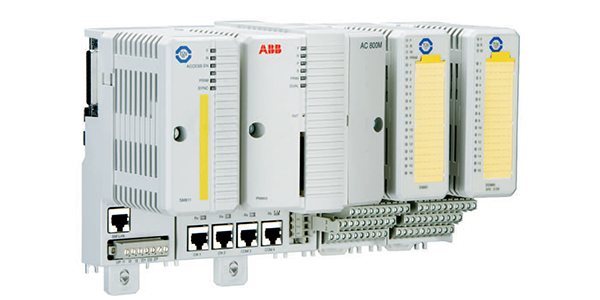
A Qinghai limited liability company has invested in the construction of a 1 million ton/year coking project. Due to its location on a plateau, in order to improve productivity and ensure the continuous safe and stable operation of the system, the company has selected the widely used ABB AC800F system. The ABB AC800F DCS system is a control platform based on Industrial IT, which has a high level of industrial automation. It adopts an open integrated controller, the latest technology and standards, and has the characteristics of information aggregation, high engineering efficiency, advanced upgradable solutions, open communication, and plug and play. It also has an open integrated controller and a global data management system, making it a world leading automation control system that integrates the advantages of DCS and PLC.
2. Project Introduction
The company is a comprehensive large-scale privately-owned enterprise group integrating mining, beneficiation, metallurgy, and coal chemical industries. In order to adapt to harsh environments, considering the informationization and automation of modern enterprises, as well as the needs of sustainable development, the latest technology has been applied in the newly built 1 million tons/year coking project. ABB AC800F control system has been selected, which has an Industrial IT control platform and is based on fieldbus to improve the company’s informationization and automation level. The S800 series has been selected as the distributed process station for the I/O module, making work easier.
3. Characteristics of AC800F Controller
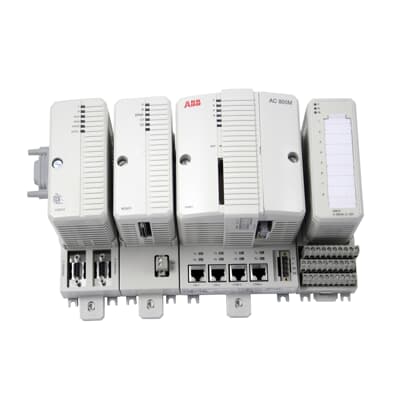
The AC800F controller is a world leading automation control system launched by ABB, integrating the advantages of DCS and PLC, and supporting multiple international fieldbus standards. It not only has the complex simulation loop adjustment capability of DCS, friendly human-machine interface (HMI), and convenient engineering software, but also has high-speed logic and sequential control performance comparable to high-end PLC indicators. The system can connect to both conventional I/O and various fieldbus devices such as Profibus, FF, CANModbus, etc. The system has high flexibility and excellent scalability, and can handle control of small production units, large-scale integrated control of the entire plant, and even cross plant management and control applications with ease. After upgrading to version 7.1 or above, the system capacity can reach an infinite number of points (over 1 million I/O). In the future, if the system needs to be expanded, I/O or fieldbus instruments can be directly added on this basis, which is beneficial for future development. The AC800F system elevates ABB’s control system from a traditional process automation control concept to a factory production management system based on information technology for the entire factory. Its purpose is to provide users at all levels with the most accurate and detailed information they need at the most appropriate time and from the most suitable perspective, enabling them to operate factory production efficiently. The system can be divided into operation management level and process control level. The operation management level includes the operation station OS, engineer station ES, and gateway GS.
At the operational management level, it can not only achieve traditional control system monitoring and operation functions (predefined and free-form dynamic screen display, trend display, pop-up alarm and operation guidance information, report printing, hardware diagnosis, etc.), but also complete management functions such as formula management and data exchange. The process control level can be composed of one or several process stations, each of which includes AC800F and extended I/O S800 units.
The process station CPU and I/O units can be configured as redundant or non redundant systems, and the system has various I/O modules that can be connected to various process signals on site.
Compared with other distributed control systems, combined with the development history of AC800F control system, we have summarized the new technologies of the system as follows:
(1) Open fieldbus technology
Although the project does not currently use fieldbus type field instruments, in order to facilitate the future development of users, we have reserved bus hardware interfaces. In terms of software, the Profibus template of ABB AC800F controller supports DPV1. Compared with pure DP standard modules, standard modules have increased the ability to configure instruments. This eliminates the need to install specialized configuration software for various instruments, and only imports the equipment parameter files (GSD files) of each instrument to achieve the function of programming and configuring parameters for all PA standard instruments under a unified system programming software. This function effectively saves software costs and improves the efficiency of engineering configuration.
(2) Open control function
The system controller adopts RISC processor chip, and the program adopts task running mode. Each task can set the running cycle and priority. So it can meet the control requirements of complex regulation circuits (generally requiring longer control cycles), as well as fast electrical switch control, so that one controller can cover all control requirements of the factory. A large number of user-defined control function blocks are reserved during programming, and users can add or remove functions according to future production needs. The application of the IEC61131-3 programming standard enables users to quickly familiarize themselves with the system programming as long as they have some basic knowledge.
(3) System global database technology
The core technology of the global database system is “decentralized storage and global management”. The system programming software only generates one project file for the project. Although each controller opens up a certain space as a data variable storage area, on the system programming software, it is only a global system variable table. The data exchange between the operator station and the process station does not require database conversion programming to direct access. The modification and inspection of variables are also system global, and the configuration of the process station and the operator station of the system is a set of software. The installation, debugging, and start-up of the entire self-control part of the project only took two to three weeks, which is a very important factor.
(4) Open TCP/IP protocol
Ethernet technology is used in operator stations, engineer stations, and process TCP/IP protocol Ethernet modules, allowing the system to connect to the factory LAN without the need for additional equipment. Due to the system’s support for standard DDE and OPC data exchange standards, data exchange between the system and various third-party databases or software will be easier.
(5) The system is easy to expand
The system software has no resource limitations. If users need technical upgrades in the future, they do not need to purchase new control points, process stations, or engineer station software. When programming, only a few resources can be added under the original project file tree, which facilitates users’ future system expansion and long-term development.
(6) Chinese interface
The system menu, operation panel, system character table, and system prompt information are all in Chinese.
4. Characteristics of S800 I/O Station
The I/O modules of Industrial IT are intelligent modules with built-in CPUs, mainly used for signal conditioning, A/D, D/A conversion, and various data preprocessing including linearization and engineering unit conversion.
S800 I/O, as a distributed process I/O station, is designed as a module that is economical, flexible, easy to install, wired, and can be directly connected to the transmission system. Its modules and wiring terminals can be combined arbitrarily to meet different space and application requirements.
S800 I/O can communicate with higher-level control systems through Profibus DP or ABB AF100 fieldbus. At the same time, it can be connected to ABB transmission equipment, with module status display and other practical functions, and can also be remotely tested through fieldbus. The data is scanned through the fieldbus at a certain cycle through the I/O module, with a scanning period of 4-108ms according to the module type. S800 I/O has full redundancy function, including bus interface module redundancy and bus medium redundancy I/O module redundancy. It can achieve disturbance free switching, and all outputs can be forced or pre-set. I/O modules are locked with mechanical locking keys and wiring terminals, and all modules can be plugged in and out with power on. Provide intrinsic safety modules and HART communication, convert HART protocol to Profibus DP V1, and configure using DTM. The status display of each module and channel is prone to error diagnosis, and all modules are injection molded with a protection level of IP20. The S800 I/O station is rail mounted, which can be installed horizontally or vertically. Compact and expandable terminals can be mixed and installed together. Choosing extension cables can make installation more flexible to meet the requirements of different installation spaces.
5、System composition scheme
The system is equipped with four process stations and eight operator stations: the engineer station uses industrial PC machines (portable machines can also be used) as the commissioning equipment, and according to the coalification process and the layout diagram on site, we have established a total of 4 process stations; the system operator station runs on industrial PC machines, and the operation interface developed based on the MS Windows NT platform is a full Chinese Digivis software package, which enhances the system’s use and operation functions with its graphical operation interface. In addition, the external device indicators of the PC machine, such as the display, printer, mouse, and keyboard, can be improved, making the system operation more convenient. According to the requirements of the factory, one or two operator stations are established corresponding to the four process stations, and each operator station can only monitor and operate the information of the corresponding process station. The specific structure is shown in Figure 1.

The entire system is designed to be safe and reliable. The industrial Ethernet adopts a redundant network topology, which has high reliability and safety. Even if the operator station or engineer station is closed or all of them are closed, the system will not shut down as long as the process station is not shut down. The process station adopts a redundant mode with dual-machine hot standby. Both the controller EI modules can be equipped with batteries, which can maintain normal operation for 20 milliseconds in the event of a power outage. When a controller fails, the system will automatically switch to the other controller, achieving smooth switching and synchronization between the master and slave AC800F controllers. Therefore, the entire system has a high degree of safety. Not only the controllers can be redundant, but all the inputs and outputs also support redundant configuration, which can further improve the reliability of the system. However, using input and output redundancy will increase the cost, so we only use controller redundancy.
The communication template for the AC800F controller system is a standard TCP/IP protocol Ethernet module, which allows the system to connect to the enterprise LAN without the need for additional devices. Due to the system’s support for standard DDE and OPC data exchange standards, data exchange between the system and various third-party databases or software will be easier, bringing convenience to real-time data management on site and enterprise information management systems.
6. Process implementation
According to its process, it will be divided into various job stations such as “coke screening system”, “coal preparation”, “desulfurization and sulfur recovery”, “ammonium sulfate”, “benzene washing”, “comprehensive water supply”, “biochemical treatment”, “coking”, “refrigeration station”, “air compression station”, “tank area”, etc. During system design, create a workflow diagram for the job station. We have created many macro libraries in the image, which not only facilitates the drawing of the operator’s screen, but also ensures the unity and beauty of the screen. Multiple dynamically displayed bar charts were created on the operator station’s interface, which not only vividly described the changes in variables but also avoided visual fatigue for operators. Many graphic symbols were also created in the images. These graphical symbols not only represent the current state of variables, but also allow operators to call the corresponding variable operation panel through these symbols, use software logic control, control the pump’s on/off, manual/automatic switching, and predefined or operational values of variables.
Coke ovens are crucial in the coking industry, as the temperature inside the oven directly affects the quality of the refined coke. Therefore, we must ensure that the temperature inside the oven remains stable within a reliable range. Therefore, we have adopted a composite control method for the pressure control of the coke oven flue and gas main pipe, which includes feedforward and feedback/manual switching to meet the control requirements. The liquid level in the benzene washing condensate storage tank, the temperature at the top of the ammonium evaporation tower, and the pH value of the ammonium water were automatically adjusted. Due to the fact that the SP value (set value) of many adjustment circuits is an uncertain number, it needs to be adjusted according to the requirements of different periods; In the design of PID regulation and manual/automatic switching, we designed SP to track PV during manual operation, and adjust the process value based on the SP value during switching during automatic operation. This way, when the operator switches from manually adjusting the process value to automatic, the process value can be adjusted immediately. Facilitating operators to further explore methods to improve work efficiency.
Creating trend charts of important variables such as “bottom pressure of ammonium evaporation tower” and “liquid level of regeneration tower” on the operation interface of the operator station is beneficial for operators to intuitively observe the changing trends of important data. We used the signal sequence function to record the changes in each operation, with the fastest scanning cycle being two milliseconds. This allows us to clearly record the sequence of data changes, and when an accident occurs, we can refer to this data to analyze the cause of the accident. We have also created a database to accumulate and record important variables in the process of “coal preparation”, “coke screening”, “tank area”, etc. Enterprises can analyze the production process based on the data, optimize the production process, and continuously improve efficiency.
The OPC standard software interface has been designed in the system, providing a foundation for on-site data management in enterprises. At the same time, it provides a guarantee for enterprises to achieve information management.
7. Summary
The factory has now been put into production. According to the design requirements, the entire system is designed to produce 1 million tons of coke per year annually, and the DCS control system provides guarantee for achieving this goal. The ABB AC800F distributed control system operates stably and reliably, while also providing convenience for enterprise information management. Practice has proven that DCS control systems have made contributions in improving labor productivity, enhancing product quality, and avoiding accidents, bringing considerable economic benefits to enterprises and achieving satisfactory results for users.