


Description
I. Brand Background

II. Product Features
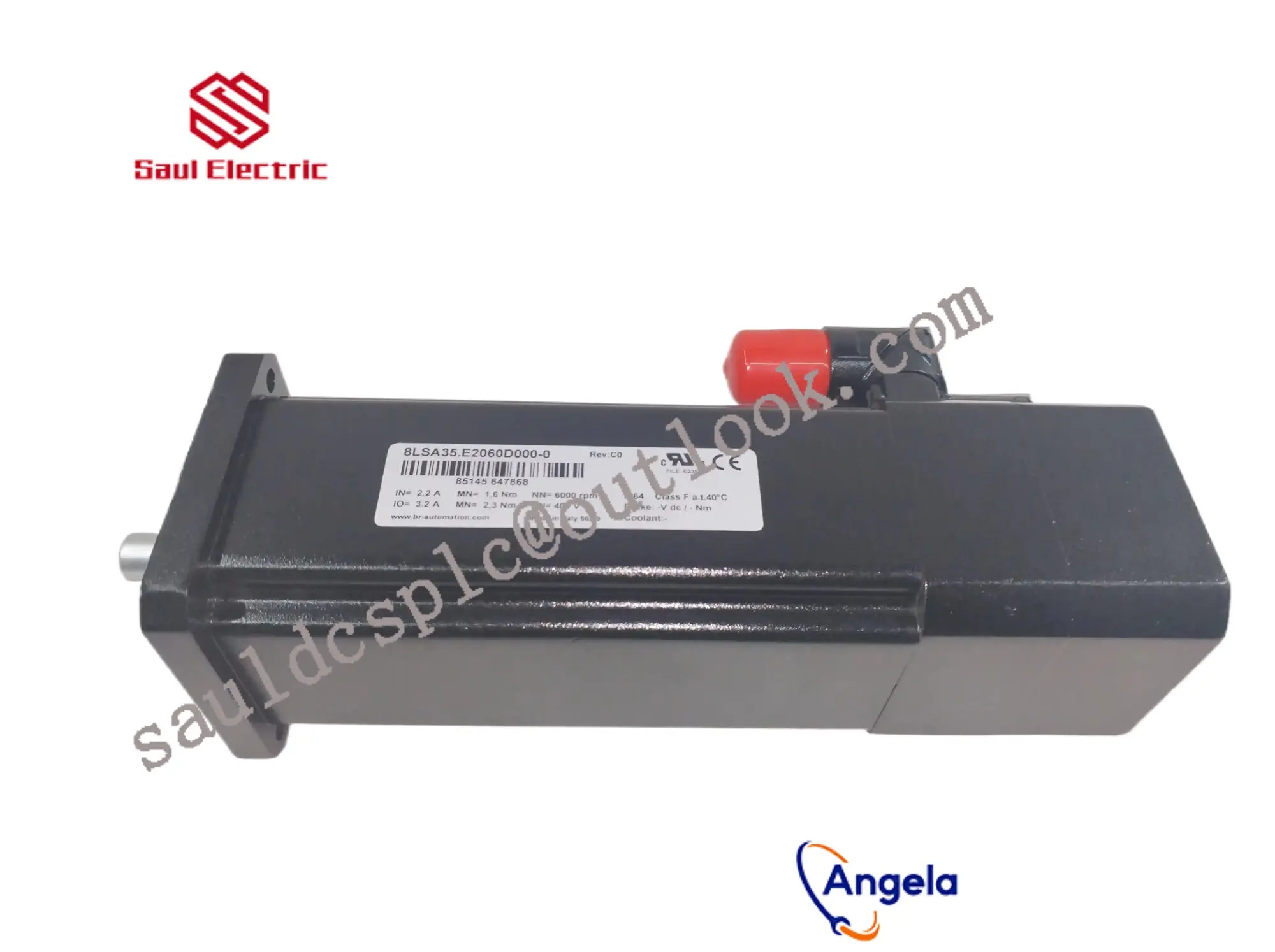
- High Performance: The 8MSA4M.E1-30 servo motor offers high precision, rapid response, and excellent stability, meeting the demands of various complex automation applications.
- Integrated Safety Technology: B&R”s servo motors incorporate advanced safety technologies, such as the openSAFETY standard,
- ensuring the safety of operators while supporting machine functionality. This safety technology adapts to changing configurations and operates reliably worldwide.
- Easy Management: With intelligent safety response capabilities, the 8MSA4M.E1-30 servo motor simplifies machine option management without compromising safety levels.
- This helps reduce downtime risks and enhance production efficiency.
- Networked Collaboration: B&R”s integrated, networked safety technology enables coordinated responses to safety events across the entire production line.
- The use of safety standards like openSAFETY ensures secure communication and interoperability between devices from different manufacturers.
- Powerful Software Support: B&R”s Automation Studio software development platform provides robust support for configuring, commissioning,
- and maintaining servo motors. Users can easily accomplish various automation tasks through this platform.
III. Application Areas

IV. Product Advantages
- Genuine Products: The 8MSA4M.E1-30 servo motor is manufactured in Austria, ensuring product quality and performance.
- Professional Services: B&R has a professional technical support and after-sales service team capable of providing timely and efficient technical support and solutions to users.
- Customization Options: B&R offers customized servo motor solutions to meet the specific needs of different users.
The main difference between variable frequency motors and rated motors lies in their driving methods and application scenarios.
Driving mode:
The speed of a rated motor is constant, determined by the frequency and number of poles of the power supply. The variable
frequency motor can control the motor speed by changing the frequency and voltage of the power supply to meet different working requirements.
Application Scenario:
Rated motors are usually suitable for applications with stable loads, such as ventilation, water pumps, compressors, etc.,
because their speed is fixed and cannot adapt to load changes.
Variable frequency motors can adjust their speed in real-time according to changes in load, making them suitable for applications
that require frequent speed adjustments, such as fans, cooling towers, conveyors, etc.
In addition to the driving method and application scenarios, there are also some structural differences between variable frequency motors and rated motors. Mainly reflected in:
Differences in magnetic materials:
The magnetic material of variable frequency motors usually uses high-performance rare earth permanent magnet materials,
while the magnetic material of rated motors usually uses ordinary permanent magnet materials or electromagnets.
Different cooling methods:
Due to the need for speed control through a frequency converter for variable frequency motors, their heat generation is relatively high.
Therefore, air or water cooling is usually used for heat dissipation to ensure the normal operation of the motor.
Rated motors usually use natural or forced air cooling for heat dissipation. Due to their fixed speed and relatively low heat generation,
complex cooling methods are not required.
In summary, there are some differences between variable frequency motors and rated motors in terms of driving methods, application scenarios,
and structural design. Users should choose the appropriate motor type based on their actual needs when selecting a motor.
In addition, due to the ability of variable frequency motors to adjust speed according to load requirements, energy consumption can
be greatly reduced and energy utilization efficiency can be improved. Therefore, under the requirements of energy conservation and
emission reduction, the application of variable frequency motors is becoming increasingly widespread.