


Description
I. Brand Background
II. Product Features
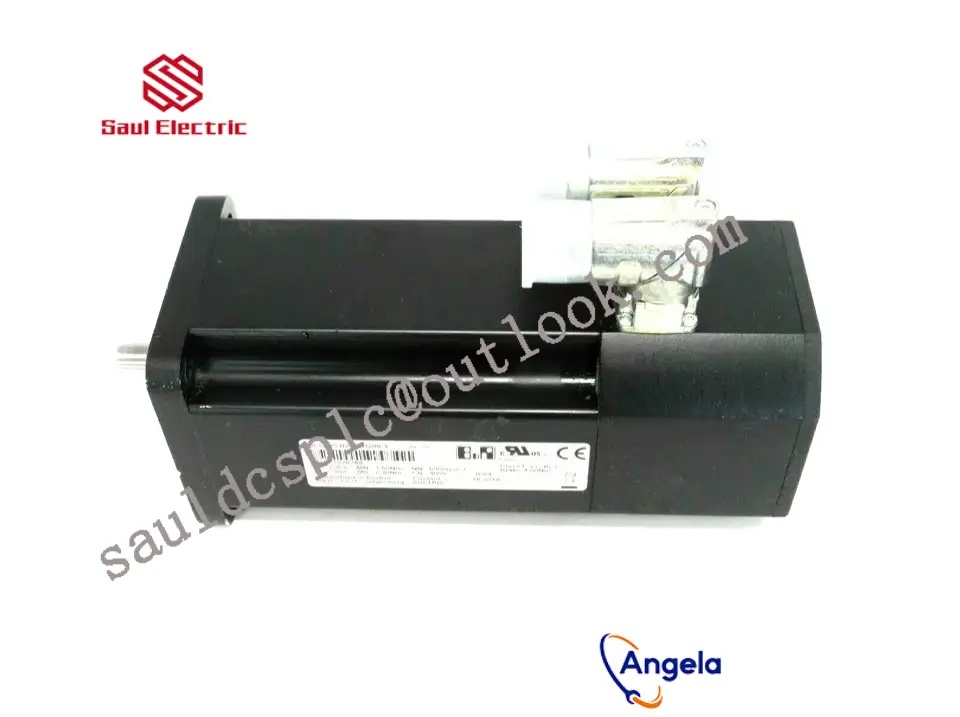
- High Performance: The 8LSA37.DB030S200-3 servo motor offers high precision, rapid response, and excellent stability, meeting the demands of various complex automation applications.
- Integrated Safety Technology: B&R”s servo motors incorporate advanced safety technologies, such as the openSAFETY standard,
- ensuring the safety of operators while supporting machine functionality. This safety technology adapts to changing configurations and operates reliably worldwide.
- Easy Management: With intelligent safety response capabilities, the 8LSA37.DB030S200-3 servo motor simplifies machine option management without compromising safety levels.
- This helps reduce downtime risks and enhance production efficiency.
- Networked Collaboration: B&R”s integrated, networked safety technology enables coordinated responses to safety events across the entire production line.
- The use of safety standards like openSAFETY ensures secure communication and interoperability between devices from different manufacturers.
- Powerful Software Support: B&R”s Automation Studio software development platform provides robust support for configuring, commissioning,
- and maintaining servo motors. Users can easily accomplish various automation tasks through this platform.
III. Application Areas
IV. Product Advantages
- Genuine Products: The 8LSA37.DB030S200-3 servo motor is manufactured in Austria, ensuring product quality and performance.
- Professional Services: B&R has a professional technical support and after-sales service team capable of providing timely and efficient technical support and solutions to users.
- Customization Options: B&R offers customized servo motor solutions to meet the specific needs of different users.
Principle and Application of Stepper Motor
A stepper motor is a type of motor that can rotate according to a certain number of steps, and its working principle is to use changes in electromagnetic fields to drive the motor to rotate.
A stepper motor is mainly composed of a stator and a rotor, with multiple electromagnetic coils on the stator and multiple magnetic poles on the rotor. When the electromagnetic coil is energized,
a magnetic field is generated that attracts the rotor to the position where the electromagnetic coil is located. By sequentially energizing different electromagnetic coils, the motor can rotate in a certain number of steps.
Stepper motors have the following characteristics:
High precision: Due to the stepper motor rotating according to a certain number of steps, very accurate angle positioning can be achieved, with an accuracy usually reaching 0.01 degrees.
High reliability: The stepper motor has a simple and durable structure, is not easily damaged, and can operate stably for a long time.
Relatively low cost: Due to the simple structure and relatively low manufacturing cost of stepper motors, the price is relatively low.
Stepper motors are widely used in many fields, including:
Machine tool: Stepper motors can be used to control the movement of machine tools, achieving functions such as positioning and feed during the machining process.
3D printing: Stepper motors can be used to control the nozzle position of 3D printers, achieving precise printing control.
Robots: Stepper motors can be used for joint drive of robots to achieve motion and posture control.
Automation equipment: Stepper motors can be used for positioning and motion control of various automation equipment.
The difference between stepper motor and servo motor:
The feedback control methods are different: stepper motors are controlled based on input pulse signals, without feedback control, so they cannot perceive and correct position errors;
The servo motor obtains actual position information through feedback devices (such as encoders), compares it with the set position, and adjusts
the motor speed and direction through control signals to make the actual position consistent with the set position.
2. Different application scenarios: Stepper motors are suitable for situations that require precise positioning and low speed, such as printers, plotters, etc;
Servo motors are more suitable for applications that require high-precision and high-speed control, such as machine tool processing, robots, CNC equipment, etc.
Different control methods: The control of stepper motors is relatively simple, only requiring the provision of pulse signals; And servo motors require PID control,
which requires real-time adjustment of motor speed and direction through control algorithms.
A stepper motor is a type of motor that rotates according to a certain number of steps, characterized by high precision, high reliability, and relatively low cost.
It is widely used in fields such as machine tools, 3D printing, robots, and automation equipment.